Historical Context
World War II
World War II was a conflict between the Axis Powers (which consisted of Germany, Japan, and Italy) and the Allies (which consisted of France, Great Britain, the United States, the Soviet Union, and China). World War II began in 1939 when Germany, ruled by Adolf Hitler, invaded Poland. Great Britain and France reacted by declaring war on Germany. In 1941, Germany invaded Soviet Russia, bringing the USSR into the war.
Meanwhile, Japan started working toward dominating the Pacific by conquering and oppressing countries such as Taiwan, Korea, Vietnam, and China. On December 7th, 1941, Japan attacked the US military base of Pearl Harbor in order to damage the American fleet to prevent them from interfering in their conquests. Three days later, the US declared war on Japan, officially inducting itself into World War II.
World War II would eventually become the bloodiest conflict in history with over 40,000,000 total deaths involving almost every country in the world.
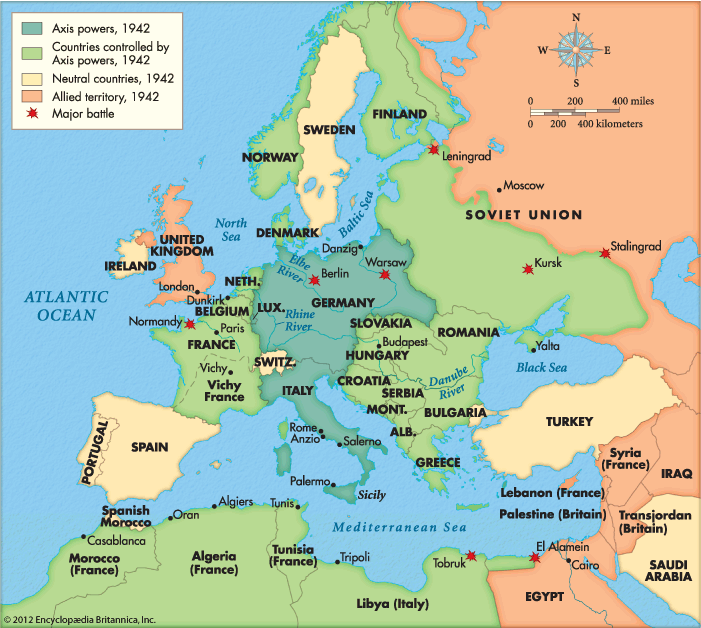

Photo by The Print Collector - Getty Images / CC BY
Adolf Hitler, dictator of Germany, inspecting the troops of the Schutzstaffel.

Photo by Reuters / CC BY
The USS Virginia and USS Tennessee burn as Japanese Aircraft Attack Pearl Harbor
Photo by Encyclopedia Britannica / CC BY
This map shows the territory of the Axis powers and the territory of the Allied powers in 1942. To reference, 1942 was the year after the attack on Pearl Harbor.

Photo by Encyclopedia Britannica / CC BY
This map shows the greatest extent of Japanese expansion in 1942.
The Manhattan Project
During World War II, the scientific community discovered that the Germans might be creating a nuclear bomb. Because of this, the United States, with the urging of scientist Albert Einstein, quickly started its own nuclear weapons program in late 1941 dubbed the Manhattan Project. These scientists understood the great power of the atomic bomb and how dangerous it could be.


Albert Einstein
Albert Einstein was a theoretical physicist who came up with the famous theory of relativity. He is also famous for his work in scientific philosophy. He and many of his fellow physicist found out about Germany’s rapid development of nuclear fission and realized...
Photo by Truman Libary / CC BY
Albert Einstein’s letter to Franklin D. Roosevelt, who was president at the time. The letter warned of the growing nuclear threat of Germany and suggested that the US government work with American physicist to research uranium chain reactions and develop the nuclear bomb.
The Manhattan Project led by J. Robert Oppenheimer began as a modest research and development effort, but slowly grew to employ over 130,000 people and cost the American government $2 billion (22 billion dollars in today’s money). The project had the support of the Allied forces, as well as many world renowned scientists and physicists, including the German Has Bethe, a scientist who escaped Germany following the rise of Nazi Germany. In 1945, the Manhattan project successfully detonated the first atomic bomb in New Mexico.

Photo by Jack Aeby / CC BY
The first ever nuclear bomb exploding during the Trinity test in the Jornada del Muerto desert.
The Dropping of the Atomic Bomb
Because of the success of the Manhattan Project, President Harry Truman knew that he had the means to end the war quickly, but he also knew how destructive this weapon was.
The Allies had demanded that Japan surrender unconditionally and said that a refusal would result in total destruction. But the Japanese refused to do so, stating that they would fight to the death. (They did not know their refusal would result in a nuclear attack.) So on August 6, a U.S. B-29 bomber known as Enola Gay dropped an atomic bomb code-named "Little Boy" on the Japanese city of Hiroshima.
The Japanese leaders had not witnessed the the great devastation in Hiroshima after the bombing and most of them underestimated the great damage which the bomb had done, so Japan did immediately surrender.
On August 9, the US dropped another atomic bomb on the Japanese city of Nagasaki code-named "Fat Man". Six days later on August 15, Japan announced its unconditional surrender.
